Understanding how much a caulker charge per hour is crucial for budgeting your next sealing project in Sydney. While many smaller jobs, particularly in residential settings, are priced hourly, larger or more complex projects often involve per-metre or fixed-project rates. This guide from Australian Caulking Experts breaks down the typical hourly rates in Sydney, explores the factors that influence these charges, and helps you navigate the different pricing models to budget accurately for your specific caulking needs.
Key Takeaways
- Hourly rates for caulkers in Sydney vary, with residential work generally at a lower rate than commercial jobs, which command higher rates due to compliance, materials and access requirements.
- Pricing models include hourly (common for small residential jobs), per-metre (for linear commercial work) and per-project (for larger, complex scopes) — choosing the right model depends on job size and predictability.
- Factors like job type, access difficulty, sealant material and compliance requirements significantly influence the hourly rate a caulker will quote.
- Specialist services such as fire-rated caulking command premium rates due to specific materials and regulatory compliance.
- Request an hourly rate for small, unpredictable jobs and a fixed project quote for larger, clearly defined scopes — then compare detailed quotes for accurate budgeting.
Typical Caulking Hourly Rates in Sydney
In Sydney, the hourly rate for a professional caulker generally falls within a range, reflecting the diverse nature of sealing work and the varying levels of expertise required. For standard caulking tasks, you can typically expect a caulker charge per hour to vary depending on the job’s specifics.
This range accounts for several variables, including the caulker’s experience, the type of sealant used, and the overall complexity of the job. For instance, a highly experienced specialist from Australian Caulking Experts might charge at the higher end, especially for intricate or compliance-critical applications. Conversely, simpler tasks or those performed by less experienced tradespeople may fall at the lower end of this spectrum.
It is important to note that these hourly rates usually cover the labour component. The cost of sealant materials, consumables (such as masking tape and cleaning agents), and any specialised equipment may be billed separately or factored into a comprehensive quote. For smaller residential caulking jobs, such as sealing a few internal joints, an hourly rate is often the most straightforward way to price the work. Contact us for current pricing for your project.
Residential vs Commercial Caulking: Hourly Rate Comparison
Hourly rates differ noticeably between residential and commercial caulking work, and understanding where your project sits helps you set realistic budget expectations.
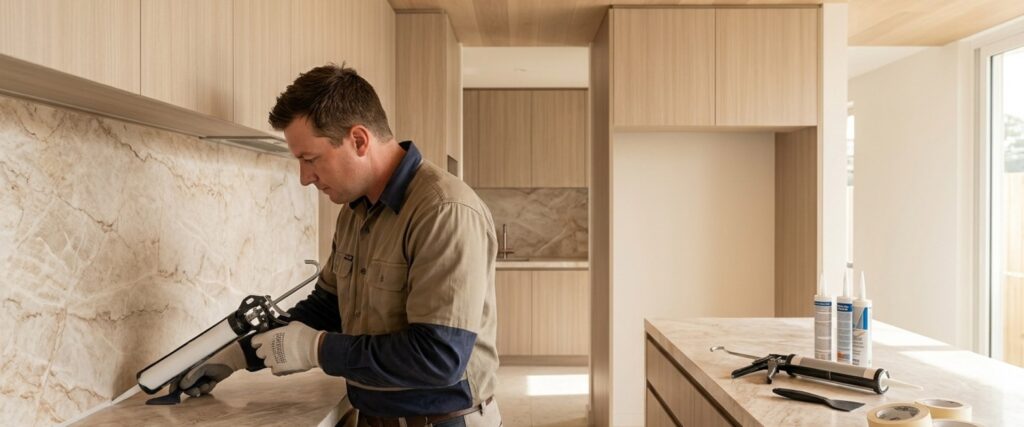
Residential caulking hourly rates in Sydney typically fall at the lower end of the pricing spectrum. Most residential caulking involves straightforward access (single-storey or easily reached areas), standard sealants such as acrylic or neutral-cure silicone, and simpler joint profiles found in kitchens, internal window frames, and skirting boards. The work is generally quicker to set up and requires less documentation.
Commercial caulking hourly rates tend to be higher. The higher rate reflects several realities of commercial caulking projects:
- Compliance and documentation: Commercial work often requires adherence to the National Construction Code (NCC) and Building Code of Australia (BCA), with detailed records of materials used, application methods, and Fire Resistance Levels (FRLs) where applicable.
- Specialist materials: Larger joint profiles, structural polyurethane sealants, or fire-rated caulking products drive up both material and labour costs.
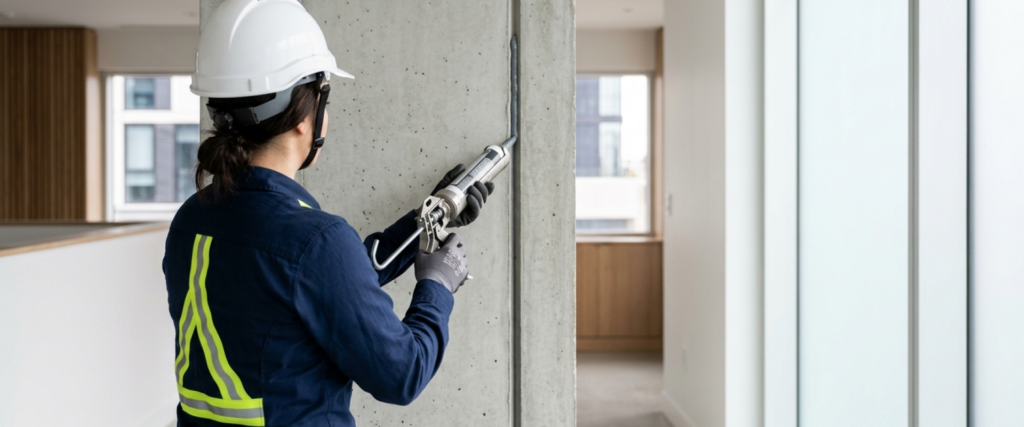
- Access and safety: Multi-storey facades, plant rooms, and service risers frequently require scaffolding, elevated work platforms, or rope access, each adding setup time and safety overhead governed by Safe Work Australia requirements.
- Site inductions and scheduling: Active commercial sites often mandate safety inductions, restricted working hours, and coordination with other trades — all of which reduce productive sealing time per hour on site.
If your project straddles both categories — for example, a residential strata block with common-area fire-rated sealing — expect rates closer to the commercial end for the compliance-critical components and residential rates for the standard internal work.
How Caulkers Price Their Work: Hourly, Per Metre and Per Project
Professional caulking services employ different pricing models depending on the scope, scale, and nature of the project. Understanding these models is key to getting an accurate estimate and managing your budget effectively.
Hourly Rate Pricing
The hourly rate is most commonly applied to smaller, less predictable jobs, particularly in the residential caulking sector. This model is ideal for tasks where the exact amount of work cannot be precisely quantified upfront, such as:
- Minor remedial caulking or repairs.
- Sealing a small number of internal window frames.
- Patching up isolated gaps in skirting boards.
- Small-scale kitchen caulking costs where only a few specific joints require attention.
When working with an hourly rate, ensure you discuss estimated timeframes with your caulker to avoid unexpected costs. Australian Caulking Experts provides transparent estimates to help you plan.
Per-Metre Pricing
For larger projects involving extensive linear sealing, such as expansion joints, facade cladding, or long runs of internal skirting, caulkers often price their work per linear metre. This model is particularly prevalent in commercial caulking and industrial settings where consistency and scalability are important.
The per-metre rate typically includes both labour and material costs, making it easier to budget for large-scale applications. Factors influencing the per-metre rate include the type of sealant, joint width and depth, and the complexity of the application surface.
Per-Project Pricing
For complex or extensive projects, such as an entire new build, a multi-story facade sealing, or a comprehensive fit-out, caulkers may provide a fixed per-project quote. This model offers the most financial certainty, as the total cost is agreed upon upfront, regardless of minor variations in time or materials.
Project-based pricing typically encompasses all aspects of the job, including labour, materials, site preparation, clean-up, and any compliance documentation. This approach requires a detailed site inspection and scope definition to ensure all parties are aligned on the deliverables.
Choosing the right pricing model depends entirely on your project’s scale and complexity. For a quick fix, hourly rates make sense. For large-scale developments, a project-based quote provides predictability and peace of mind.
What Affects a Caulker’s Charge Per Hour
Several critical factors influence how much a caulker charge per hour in Sydney. Understanding these can help you anticipate costs and make informed decisions for your project.
Discuss Your Caulking Project
Get personalised guidance from our team on the best pricing model and factors affecting your specific caulking job in Sydney.
1. Job Type and Complexity
The specific nature of the caulking job plays a significant role in determining the hourly rate. Simple, straightforward tasks, such as sealing a few internal joints on an easily accessible surface, will generally incur lower hourly rates. More complex jobs, however, demand greater skill and time:
- Remedial Work: Remedial caulking, which involves the removal of old, failed sealant before re-sealing, is more labour-intensive and time-consuming than applying sealant to a new, clean joint. This additional preparation work naturally increases the hourly rate.
- Specialist Applications: Tasks like expansion joint sealing or sealing around intricate architectural features require precision and specialised techniques, leading to higher hourly charges.
2. Access Difficulty and Safety Requirements
Access to the work area is a major factor, particularly for external caulking on high-rise buildings or complex structures. Difficult access often necessitates additional equipment and safety measures, which are reflected in the hourly rate:
- Height Work: Jobs requiring scaffolding, elevated work platforms (EWP), or rope access are more hazardous and take longer to set up and execute, leading to premium rates. Safe Work Australia guidelines must be strictly adhered to, adding to the operational costs.
- Confined Spaces: Working in tight or restricted areas can slow down progress and may require specific safety protocols, impacting the hourly charge.
3. Sealant Material and Application Method
The type of sealant chosen for the job directly influences both material costs and application time. Different sealants have distinct properties and application requirements:
- Premium Sealants: High-performance sealants, such as certain silicone, polyurethane and acrylic sealant formulations, are more expensive and may require more careful application techniques.
- Specialised Sealants: Materials for specific applications, like fire-rated caulking, are inherently more costly and require precise installation to meet compliance standards.
- Application Method: Some sealants require specific tooling or multi-stage application processes that add to the labour time.
4. Compliance Requirements and Certification
For many projects, particularly in commercial and multi-residential sectors, strict compliance with Australian building codes and standards is non-negotiable. This significantly impacts the hourly rate:
- National Construction Code (NCC) / Building Code of Australia (BCA): Adherence to the NCC and BCA mandates specific materials and installation methods for fire-rated and structural sealing. This often requires certified applicators and detailed documentation, which are reflected in higher charges.
- Fire-Rated Caulking: This specialist service demands specific training, certified materials, and meticulous application to achieve the required Fire Resistance Levels (FRLs). The expertise and accountability involved mean fire-rated caulking typically incurs a higher hourly rate.
5. Scope, Scale, and Urgency
The overall size of the project and any urgency attached to it can also influence hourly pricing. Larger projects may qualify for slightly reduced hourly rates if negotiated as part of a per-project quote, while small, urgent jobs (e.g., emergency repairs) might incur higher call-out fees or premium hourly rates.
How to Budget for Your Caulking Project
Accurate budgeting for a caulking project involves understanding the pricing models, identifying influencing factors, and obtaining detailed quotes. Here’s how to approach it:
1. Define Your Project Scope
Before contacting a professional, have a clear idea of what you need sealed. Consider:
- Location: Is it internal or external caulking?
- Area: How many linear metres are involved (e.g., skirting boards, window perimeters)? Or is it a specific number of fixtures (e.g., kitchen benchtops)?
- Condition: Is it new work, or remedial caulking requiring old sealant removal?
- Material: Do you have a preference for sealant type (e.g., silicone, polyurethane), or are you open to recommendations?
- Access: Are there any height or access challenges?
2. Decide Whether to Request an Hourly Rate or a Fixed Quote
The pricing model you request should match the nature of your job. Use these guidelines to decide:
Request an hourly rate when:
- The job is small and contained — a handful of joints, a single room, or a few window frames.
- The scope is hard to define precisely until the caulker sees the site (e.g., you suspect hidden gaps behind trims or deteriorated sealant of unknown extent).
- You need minor remedial caulking or a quick repair that may take a few hours.
- You want flexibility — an hourly arrangement lets you add small extras on the day without renegotiating.
Request a fixed project quote when:
- The scope is clearly defined and can be measured — for example, sealing all expansion joints across a car park level or re-caulking every window in a multi-storey building.
- The project involves compliance documentation, fire-rated caulking, or NCC/BCA certification where materials and methods must be specified upfront.
- You need budget certainty — a fixed quote removes the risk of costs creeping beyond your allocation if unexpected complications arise.
- The job spans multiple days, trades, or site areas, making hourly tracking impractical.
For mid-sized linear work — such as long runs of facade joints or skirting — ask whether per-metre pricing is available, as it often gives a clearer cost picture than either hourly or lump-sum for that type of scope.
3. Understand Pricing Models
Based on your project scope, consider which pricing model is most likely to apply:
- Small Residential Jobs: Expect an hourly rate. Ask for an estimated number of hours.
- Larger Linear Projects (e.g., Commercial): Anticipate per-metre pricing. Measure the approximate linear metres.
- Complex or Extensive Projects: A fixed per-project quote will be most suitable.
4. Request Detailed Quotes
Always obtain multiple quotes from reputable caulking contractors. Ensure each quote is detailed and includes:
- Breakdown of labour costs (hourly rate or per-metre rate)
- Material costs, specifying sealant types
- Any additional charges for surface preparation, old sealant removal, or specialised equipment
- Project timeframe
- Compliance documentation, if applicable
For complex jobs, a site visit is essential for an accurate quote. Australian Caulking Experts provides comprehensive, transparent quotes to help you budget confidently.
Frequently Asked Questions
What is the average hourly rate for a caulker in Sydney?
The average hourly rate for a professional caulker in Sydney varies depending on factors such as experience, job complexity, and the type of sealant required. Contact us for current pricing relevant to your project.
Is commercial caulking more expensive per hour than residential?
Yes, commercial caulking generally incurs higher hourly rates than residential caulking. The higher commercial rate reflects compliance documentation requirements (NCC/BCA), specialist sealant materials, more complex access and safety setups, and site induction and scheduling constraints common on active commercial sites.
Do hourly rates include materials?
Typically, an hourly rate covers the labour component only. Material costs for sealants and consumables are often billed separately or are factored into a project-based quote. It’s important to clarify this with your chosen contractor.
When is per-metre pricing used instead of hourly?
Per-metre pricing is generally used for larger projects with extensive linear sealing requirements, such as commercial facade joints, long runs of skirting, or expansion joints. This provides a more predictable cost for large-scale work.
Should I ask for an hourly rate or a fixed quote?
An hourly rate suits small, unpredictable jobs — a few joints, a single-room repair, or work where the full extent won’t be clear until the caulker starts. A fixed project quote is better for clearly defined, larger scopes where you need budget certainty, particularly when compliance documentation or multi-day timelines are involved. For mid-sized linear work, ask whether per-metre pricing is available.
Why does fire-rated caulking cost more?
Fire-rated caulking commands a higher rate due to several factors: it requires specialist, BCA-compliant materials, precise application by certified professionals, and meticulous documentation to ensure adherence to National Construction Code standards for fire safety. The expertise and accountability involved are significant.
How can I get an accurate quote for my caulking project?
To get an accurate quote, clearly define your project’s scope, including the areas to be sealed, whether old sealant needs removal, and any access challenges. Request a detailed quote from a professional caulking contractor, ideally after a site inspection for larger or more complex jobs.
Conclusion
Understanding the factors that influence a caulker charge per hour is essential for effective budgeting. While hourly rates vary for smaller, residential tasks, larger projects often benefit from per-metre or fixed-project pricing. Residential work generally incurs a lower hourly rate than commercial caulking, which, with its compliance, materials, and access demands, typically commands a higher rate. Factors such as job complexity, access, sealant type, and compliance requirements (including those from the National Construction Code and Building Code of Australia, and safety standards from Safe Work Australia) all play a role in determining the final cost.
By defining your project scope, choosing the right pricing model for your circumstances, and requesting detailed, transparent quotes from specialists like Australian Caulking Experts, based in Smithfield and servicing Sydney metro and greater NSW, you can ensure your caulking project is completed professionally and within budget.
Related resources
Ready for a Personalised Caulking Quote?
Gain budgeting confidence in your caulking project across Sydney and greater NSW. Our expert team provides transparent quotes tailored to your specific needs.