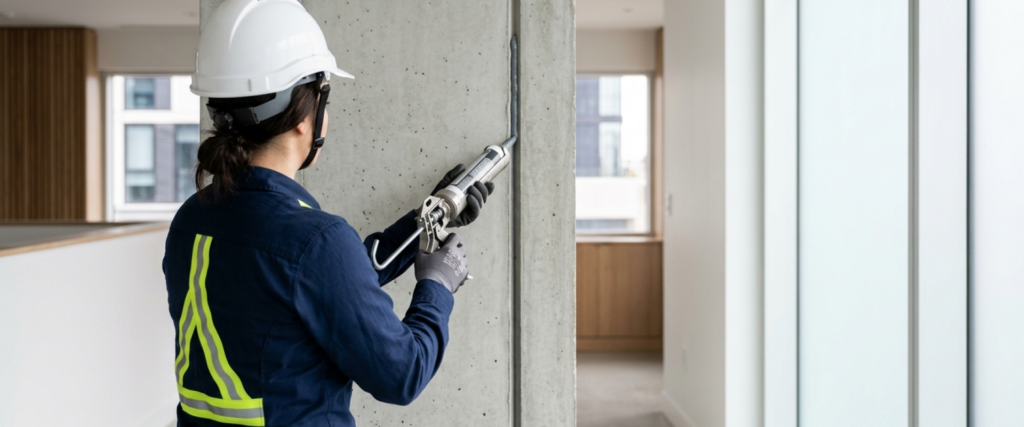
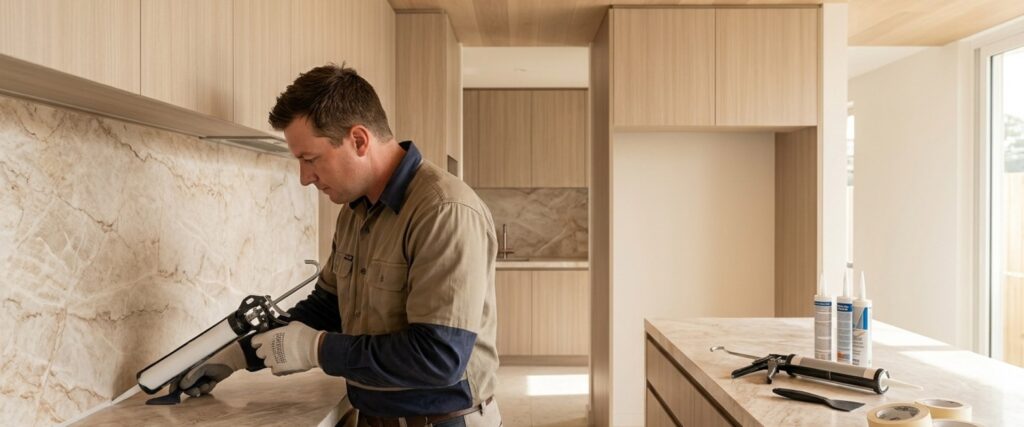
Achieving proper fire-rated caulking NCC/BCA compliance is a critical consideration for Sydney builders under NCC 2022. This passive fire protection measure is mandatory for Class 2–9 buildings, sealing penetrations and joints to maintain compartmentation and ensure occupant safety. Understanding these requirements is essential for a smooth Occupation Certificate, avoiding costly rectification orders and upholding the integrity of your projects. This article will outline what you need to know about fire-rated caulking, including FRL ratings, product selection, and essential compliance documentation.
Key Takeaways
- Fire-rated caulking is a mandatory passive fire measure under NCC 2022 (Volume One) for all Class 2–9 buildings, sealing penetrations, construction joints and service risers to maintain compartmentation.
- Non-compliant or poorly installed fire sealants are among the most common defects flagged during certification inspections — and rectification costs far exceed getting it right the first time.
- Engaging a specialist fire-sealing contractor like Australian Caulking Experts ensures tested systems, correct product selection and full documentation for BCA sign-off.
Why Fire-Rated Caulking Matters in Modern Construction
Every multi-storey building in Sydney relies on passive fire protection to contain flames and smoke within compartments, buying occupants critical evacuation time. While sprinklers and alarms grab headlines, it’s the unsexy work inside walls, floors and shafts — fire-rated caulking, intumescent collars and penetration seals — that actually holds the fire compartment together.
Under the National Construction Code (NCC), formerly referenced as the BCA, fire-resistance requirements apply to every service penetration, construction joint and linear gap that breaches a fire-rated element. A single unsealed cable tray or poorly filled pipe penetration can compromise an entire floor’s Fire Resistance Level (FRL). Ensuring proper fire-rated caulking NCC/BCA compliance is essential.
For Sydney builders, developers and certifiers, understanding these obligations isn’t optional — it’s the difference between a smooth Occupation Certificate and a costly remediation order.
The Human Cost of Non-Compliance
The 2017 Grenfell Tower tragedy and subsequent reviews of Australian high-rise stock exposed systemic failures in passive fire systems. NSW’s Building Legislation Amendment (Cladding and Fire Safety) Act 2020 tightened enforcement, and certifiers now scrutinise penetration sealing with far greater rigour than a decade ago. This underscores the importance of fire-rated caulking NCC/BCA compliance.
NCC/BCA Requirements for Fire Penetration Sealing
The NCC 2022 Volume One sets out performance requirements under Section C — Fire Resistance. The clauses most relevant to fire-rated caulking include:
- Specification C1.1 — FRL requirements for building elements (walls, floors, shafts)
- Clause C4.2 — Protection of openings in fire-resisting construction
- Specification 17 (formerly Spec C3.15) — Penetrations in fire-resisting construction, mandating tested and listed systems
- AS 4072.1 — Components for the protection of openings in fire-resistant separating elements (service penetrations)
- AS 1530.4 — Fire-resistance test of elements of building construction
What “Tested System” Actually Means
The NCC doesn’t allow ad-hoc sealant application. Every penetration must be sealed using a tested and listed system — meaning the exact combination of substrate type, penetration size, service type, sealant product and depth has been fire-tested to AS 1530.4 and documented in the manufacturer’s Product Technical Statement. This is crucial for achieving proper fire-rated caulking NCC/BCA compliance.
Using the wrong product thickness, applying sealant to an untested substrate or omitting required backing materials invalidates the system — regardless of how good the workmanship looks visually.
FRL Ratings Explained
FRL is expressed as three numbers (e.g., -/120/120) representing structural adequacy, integrity and insulation in minutes. Fire-rated caulking must match or exceed the FRL of the element it penetrates. In most Sydney residential towers (Class 2), inter-tenancy walls require -/60/60 while floor slabs typically demand -/120/120. Achieving this is key to fire-rated caulking NCC/BCA compliance.
Types of Fire-Rated Caulking Systems for NCC/BCA Compliance
Not all fire sealants are created equal. Product selection depends on the joint type, movement capability, substrate and required FRL. The three main categories used across Sydney construction are:
Intumescent Acrylic Sealants
These water-based sealants expand (intumesce) when exposed to heat, sealing gaps as services melt or burn away. Ideal for plastic pipe penetrations, mixed-service bundles and smaller linear joints. They’re paintable, low-odour and suit internal applications.
Intumescent Graphite-Based Mastics
Higher-performance systems used in larger annular gaps, cable tray penetrations and mechanical riser seals. These offer greater expansion ratios and are often specified where FRL -/120/120 is required through thick concrete slabs.
Silicone-Based Fire Sealants
Where movement accommodation is critical — curtain wall perimeter joints, expansion joints in car parks, facade-to-slab interfaces — neutral-cure silicone fire sealants provide flexibility without cracking. They resist UV and moisture, making them suitable for exposed or semi-external applications. This type of fire-rated caulking NCC/BCA compliance is vital for flexible joints.
- Movement capability up to ±25% for dynamic joints
- Weatherproof and UV-stable for facade perimeter seals
- Compatible with aluminium, concrete, masonry and steel substrates
- Tested to both AS 1530.4 and AS 4072.1
Over 60% of passive fire defects identified in NSW strata remediation audits relate to missing, incorrect or degraded penetration seals — not structural fire elements.
Common Compliance Failures on Sydney Sites
After completing hundreds of fire-sealing packages across Sydney, our team sees the same defects repeatedly. Understanding these pitfalls helps builders avoid costly rectification and ensure proper fire-rated caulking NCC/BCA compliance:
Top Defects Flagged by Certifiers
- Wrong product for the application — general-purpose silicone used where intumescent acrylic is specified in the tested system.
- Insufficient sealant depth — manufacturer requires 20 mm minimum; installer applies 8–10 mm bead.
- Missing backing material — mineral wool or polyethylene backer rod omitted, compromising system integrity.
- Oversized annular gaps — penetration cut too large for the listed system’s maximum gap width.
- No documentation — installer cannot provide product TDS, test evidence or installation photos for certification.
- Degraded or painted-over sealant — incompatible topcoat applied, or sealant left exposed to weather beyond its service life.
The Rectification Trap
Remediating fire-sealing defects in an occupied building means accessing risers behind locked cupboards, removing ceiling tiles across multiple tenancies and coordinating after-hours access. Costs routinely exceed five to ten times the original installation price. It’s far cheaper to specify correctly and engage a qualified installer from day one for effective fire-rated caulking NCC/BCA compliance.
Ready to Get Your Fire Sealing Right the First Time?
Australian Caulking Experts delivers fully documented, code-compliant fire-rated caulking packages for builders and developers across Sydney.
Where Fire-Rated Caulking Is Required in a Building
Builders sometimes underestimate the sheer number of locations requiring fire-rated sealing. A typical 8-storey residential tower in Sydney can have thousands of individual seal points. Key locations include:
- Service penetrations through fire-rated walls and floors — electrical cables, data cabling, plumbing (copper, PVC, PEX), mechanical ductwork, gas pipes
- Construction joints — head-of-wall joints, slab-to-slab joints, wall-to-slab junctions
- Linear gap seals — curtain wall perimeter, facade-to-slab gaps, spandrel panel interfaces
- Service riser shafts — where services transition between floors through dedicated risers
- Fire door frames — perimeter sealing between door frames and fire-rated walls
- Damper and collar interfaces — sealant continuity around mechanical penetrations with dampers
The Coordination Challenge
Fire sealing sits at the intersection of multiple trades. Electricians, plumbers and mechanical contractors all create penetrations — but none of them are responsible for sealing them to FRL. Without a dedicated fire-sealing contractor coordinating hold points, penetrations get buried behind plasterboard before they’re sealed. Ensuring correct fire-rated caulking NCC/BCA compliance requires careful coordination.
This is precisely why progressive builders programme fire sealing as a distinct trade package rather than leaving it to individual services contractors.
Why Specify a Specialist Fire-Sealing Contractor
General caulking and passive fire sealing are fundamentally different disciplines. Here’s what separates a specialist like Australian Caulking Experts from a generalist approach:
Product Knowledge and System Selection
Fire sealant manufacturers (Hilti, Bostik, Sika, Tremco) each maintain libraries of hundreds of tested systems. Selecting the correct system requires cross-referencing:
- Substrate type and thickness
- Service type, size and material
- Annular gap dimensions
- Required FRL rating
- Movement and exposure conditions
A specialist contractor navigates these variables daily. A generalist applicator typically defaults to one product regardless of the specific system requirements — a recipe for non-compliance and a failure in fire-rated caulking NCC/BCA compliance.
Documentation and Certification Support
Modern certifiers demand complete passive fire documentation including product technical data sheets, system test evidence (AS 1530.4 reports), installation methodology statements and photographic records. Australian Caulking Experts provides this documentation package as standard, streamlining your BCA compliance pathway.
Quality Assurance on Site
Our installers are trained in manufacturer-specific application techniques, correct joint preparation, primer requirements, backing material selection and minimum cure times. We conduct internal QA inspections before calling hold points, reducing the likelihood of failed third-party audits.
Australian Caulking Experts: Your Sydney Compliance Partner
Based in Smithfield and servicing the entire Sydney metropolitan area and greater NSW, Australian Caulking Experts has built a reputation among builders, developers and certifiers for reliable, code-compliant fire sealing. We ensure your fire-rated caulking NCC/BCA compliance is met with precision.
What Sets Us Apart
- Specialist focus — we do caulking and sealing exclusively, not as a sideline to another trade.
- NCC expertise — our team understands Specification 17, AS 4072.1 and manufacturer system requirements inside out.
- Full documentation — every project receives a compliance folder with TDS, test reports, methodology and photo evidence.
- Program integration — we coordinate with your site supervisor to align fire-sealing hold points with your construction program.
- Scalable capacity — from single-level commercial fit-outs to 30+ storey residential towers.
Projects We Service
- Class 2 residential apartments and mixed-use towers
- Class 3 hotels and serviced apartments
- Class 5 commercial office buildings
- Class 6 retail and shopping centres
- Class 9a hospitals and aged care facilities
- Class 9b schools and public buildings
For further information, see business.gov.au.
Frequently Asked Questions
Is fire-rated caulking mandatory for all buildings in NSW?
Fire-rated penetration sealing is mandatory for all Class 2–9 buildings under the NCC where services penetrate fire-rated construction elements (walls, floors, shafts). Single-dwelling houses (Class 1a) generally don’t require fire-rated sealing unless they include an attached Class 10 garage with a fire-separating wall.
Can a general caulker install fire-rated sealant?
While there’s no legislated licence requirement specific to fire sealing in NSW, the NCC requires installation in accordance with the manufacturer’s tested system. Most certifiers and principal contractors now require demonstrated competency, manufacturer training and experience with passive fire systems. Engaging a generalist caulker without this expertise significantly increases the risk of non-compliant installations and failed inspections.
How long does fire-rated caulking last before it needs replacement?
Most intumescent and silicone-based fire sealants have a service life of 20–25 years when installed correctly and not exposed to physical damage, excessive UV or incompatible coatings. However, building managers should include passive fire systems in their preventive maintenance schedules, with visual inspections every 5 years as recommended by AS 1851.
What documentation do I need for my certifier?
Certifiers typically require: product technical data sheets, AS 1530.4 test reports for each system used, a penetration schedule or drawing mark-up identifying all seal locations, a methodology statement, and photographic evidence of installations (before and after close-up). Australian Caulking Experts provides all of this as a standard deliverable on every project.
What’s the difference between fire-rated caulking and standard silicone?
Standard silicone is designed purely for weatherproofing and movement accommodation — it offers zero fire resistance. Fire-rated caulking (intumescent or fire-grade silicone) is specifically formulated and tested to maintain the fire resistance of the element it seals. It expands under heat to fill voids left by melting services and prevents the passage of flame and hot gases. Using standard silicone where fire-rated sealant is required is a serious code violation.
Do you service areas outside Sydney?
Yes. While we’re based in Smithfield and the majority of our work is across Sydney metro, we regularly service projects throughout greater NSW including the Central Coast, Newcastle, Wollongong and western Sydney growth corridors. Contact us to discuss your project location.
Protect Your Project — Partner With the Experts
Fire-rated caulking isn’t a box-ticking exercise — it’s a life-safety system that demands precision, product knowledge and proper documentation. For Sydney builders and developers navigating increasingly strict NCC/BCA compliance requirements, partnering with a specialist sealing contractor eliminates risk, streamlines certification and protects your reputation. Ensuring fire-rated caulking NCC/BCA compliance is paramount.
Australian Caulking Experts has the experience, systems knowledge and documentation processes to deliver compliant fire sealing on projects of any scale across Sydney and NSW.
Visit Australian Caulking Experts Today
Based in Smithfield, Sydney — servicing builders, developers and strata managers across the entire Sydney metro and greater NSW.