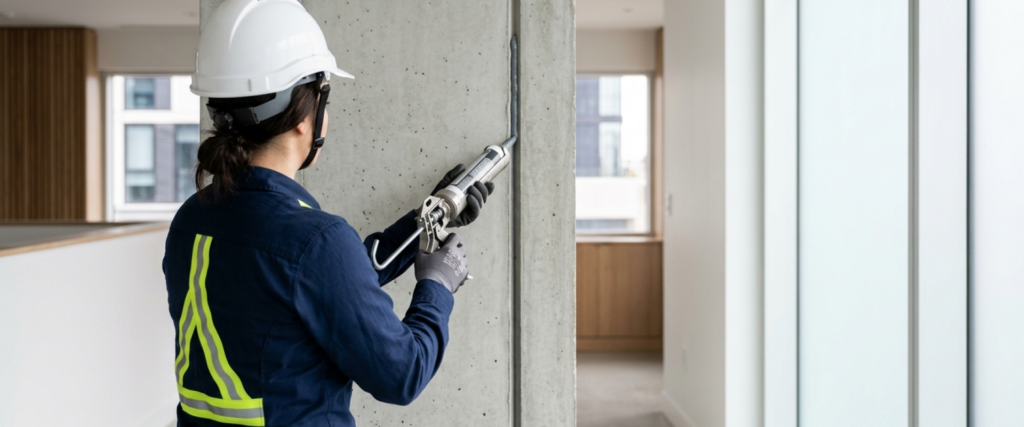
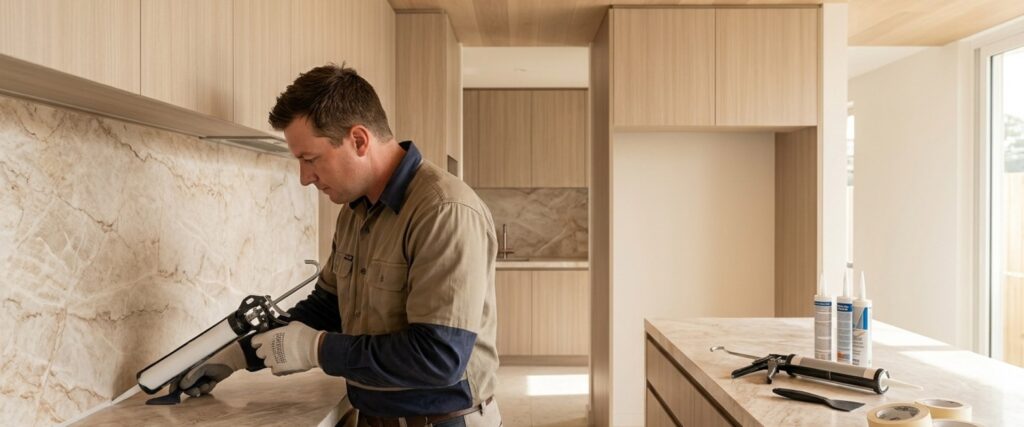
Engaging dedicated caulking specialists for commercial facades in Sydney ensures joint sealing is handled as a distinct trade scope rather than a minor add-on. Because facade joints absorb continuous movement from thermal expansion, wind load and building settlement, incorrect substrate preparation or sealant chemistry often causes premature joint failure. This article examines why surface preparation, sealant selection and fire-rated compliance require specialist skills, helping Sydney builders, developers and strata managers prevent callbacks.
Key Takeaways
- Facade joints move constantly with thermal expansion, wind load and building settlement — the sealant and the preparation behind it both have to accommodate that movement.
- Incorrect substrate preparation is the single most common cause of premature sealant failure on commercial facades.
- Polyurethane, silicone and MS polymer sealants are not interchangeable — using the wrong chemistry against the wrong substrate is a common general-trade mistake.
- Fire-rated joints have compliance requirements that go beyond visual finish, including correct product, depth and installation method.
- Engaging caulking specialists as a defined trade package, rather than folding sealing into another trade’s scope, reduces callbacks and defects on handover.
Why Facade Sealing Requires Caulking Specialists
A commercial facade is not a static surface. Panels, render, cladding and window systems all move independently as temperatures shift, as the structure settles, and as wind load flexes the building envelope. The joints between these elements are engineered to absorb that movement — but only if the sealant installed in them has the right elasticity, adhesion and depth for the gap it’s filling. Get any one of those variables wrong and the joint doesn’t fail gracefully; it fails visibly, often in a location that’s expensive or awkward to access for remedial work.
This is where the gap between a general trade and dedicated caulking specialists becomes obvious on-site. A carpenter, painter or render crew asked to “run a bead” along a facade joint is solving a cosmetic problem — closing a visible gap. A specialist caulking contractor is solving a building-performance problem: selecting a sealant chemistry and joint geometry that will still be intact and functional in ten years, under real thermal cycling and structural movement. Those are different jobs, even though they can look identical the day the scaffold comes down.
Substrate Preparation: The Step That Gets Skipped
Most facade sealant failures don’t start with a bad sealant — they start with a substrate that wasn’t properly prepared to accept one. Render, precast concrete, cladding panels and window frames each have different surface characteristics, and each needs a specific preparation approach before a bead goes in: the right cleaning method to remove dust, laitance or release agents, correct backing rod sizing to control joint depth, and in many cases a primer matched to both the substrate and the sealant chemistry being used.
General trades under program pressure will often skip or shortcut this step, because the visual result — a clean bead line — looks the same whether or not the substrate was correctly prepared underneath it. The problem only becomes visible later, when adhesion fails at the bond line and the sealant lifts or the joint opens up, usually well after the trade responsible has demobilised from site. Dedicated caulking specialists build substrate preparation into their sequencing as a non-negotiable step, because they carry the callback risk if it’s skipped — which is a very different incentive structure to a trade sealing joints as an afterthought to their primary scope.
If your current facade package has caulking bundled into another trade’s scope, it’s worth reviewing that decision before the next stage of the build locks it in — Australian Caulking Experts can be reached on 1300 941 683 to discuss scope, program fit and site-specific requirements for your project.
Sealant Selection: Polyurethane, Silicone and MS Polymer Are Not Interchangeable
One of the most common errors on commercial facades is using a single sealant type across every joint on a building, regardless of what that joint actually needs to do. Polyurethane sealants offer strong movement accommodation and paintability, which suits many render and concrete expansion joints, but they are not always the right choice against every cladding substrate or in every exposure condition. Silicone performs differently again — generally excellent movement capability and weathering resistance, but with its own compatibility limitations depending on what it’s bonding to and whether the joint will later need to be painted or overcoated.
Choosing correctly requires understanding the substrate, the expected joint movement, the exposure to sun and weather cycling, and how the joint sits within the broader facade design — technical judgement that sits squarely within a specialist caulking contractor’s expertise, not a general trade’s. Builders and developers who want a clearer breakdown of how these sealant families differ and where each is appropriate can review our guide on silicone vs polyurethane vs acrylic sealant selection, which sets out the practical differences in more depth.
Fire-Rated Joints Carry Compliance Risk General Trades Rarely Understand
Fire-rated caulking is one of the clearest examples of why this work belongs with a specialist trade rather than whoever happens to be finishing a facade package. Fire-rated joints in facade systems, where the sealed joint has to meet a specified NCC/BCA fire rating, require specific compliant products, installed to a specific method and depth, in order to actually deliver the performance the design relies on. A joint that looks correctly sealed but uses the wrong product or incorrect installation method offers none of the protection the building certifier is expecting.
This is compliance-sensitive work, and getting it wrong doesn’t just create a defect — it can create a certification problem that surfaces during handover or a later audit, at a point where remedial access is far more disruptive and costly than it would have been during construction. Builders and project managers working through NCC and BCA-related facade requirements can find more detail in our article on fire-rated caulking and compliance for Sydney builders.
A joint that looks correctly sealed and a joint that actually performs are two different outcomes, and the difference is almost always decided before the sealant gun ever touches the surface.
Expansion and Control Joints: Where General Trades Undersize the Problem
Expansion and control joints exist specifically to let a facade move without cracking or tearing at weak points, and their performance depends heavily on correct joint width, depth and backing rod placement relative to the sealant used. A joint that’s too shallow, too narrow, or filled solid without a backing rod to create the right sealant profile will restrict movement rather than absorb it — and a restricted joint transfers that stress somewhere else, often as cracking in adjacent render or cladding.
General trades sizing these joints without engineering input tend to default to whatever gap is convenient to form, rather than what the anticipated movement actually requires. Specialist caulking contractors size and detail these joints against the movement the facade is expected to undergo, which is a calculation most general trades on a commercial site are never asked to make. Where an existing facade already shows signs of joint distress, our overview of remedial caulking covers how failed or undersized joints are typically identified and addressed.
What Builders and Strata Managers Should Ask Before Facade Sealing Starts
Before facade sealant work is scheduled, it’s worth confirming a few specifics with whoever is carrying out the scope: which sealant chemistry is being used on which substrate and why, what substrate preparation and priming steps are included, how expansion joints have been sized relative to expected movement, and — where relevant — which products and methods are being used to meet fire-rated joint requirements. If those answers aren’t readily available, that’s usually a sign the scope has been treated as incidental rather than specialist. For larger commercial and new-build projects, our page on commercial caulking outlines how this scope is typically structured and sequenced alongside other trades.
Frequently Asked Questions
What’s the real difference between a general trade sealing a joint and caulking specialists doing it?
A general trade is typically closing a visible gap as a secondary task alongside their primary scope. Dedicated caulking specialists assess substrate, movement, exposure and (where relevant) fire performance before selecting a product and method, and they carry accountability for the joint’s long-term performance rather than just its finish on handover day.
Why does substrate preparation matter so much for facade sealant longevity?
Sealant adhesion depends on a clean, correctly prepared surface. Dust, contamination or the wrong priming approach can cause a bead to look fine initially but lose adhesion at the bond line over time, leading to premature failure that’s expensive to remediate once scaffold access is gone.
Is one sealant type suitable for an entire commercial facade?
No. Different substrates, joint types and exposure conditions call for different sealant chemistries — polyurethane, silicone and MS polymer each have distinct strengths and compatibility considerations, and using one product across every joint on a building is a common source of inconsistent performance.
Why is fire-rated caulking treated differently to general facade sealing?
Fire-rated joints have to meet a specified NCC/BCA fire rating and rely on specific compliant products installed to a defined method and depth. A joint that looks sealed correctly but doesn’t meet the specified system won’t deliver the protection the design and certification rely on.
What happens if expansion joints are sized incorrectly on a facade?
Undersized or incorrectly detailed joints restrict the movement they’re meant to accommodate, which pushes that stress elsewhere — commonly showing up as cracking in adjacent render, cladding or the joint itself failing well before its expected service life.
When should caulking be scoped as its own trade package rather than bundled into another trade?
Any project with fire-rated requirements, significant facade area, mixed substrates or a compliance sign-off attached to the building envelope benefits from caulking being scoped and priced as its own package, so accountability for the finished joint sits with the trade that actually understands it.
Getting Facade Sealing Right the First Time
The cost of getting facade caulking wrong rarely shows up during construction — it shows up months or years later, as a defect claim, a failed joint, or a compliance question during an audit. By that point, remediation is almost always more disruptive and more expensive than it would have been to scope correctly from the start.
The pattern across substrate preparation, sealant selection, expansion joint sizing and fire-rated compliance is consistent: each of these is a specific technical decision, not a finishing touch. Treating them that way from the outset is what separates a facade that performs for its intended life from one that generates callbacks.
For builders, developers and strata managers planning facade works across Sydney, scoping caulking as its own trade package — with its own accountability — is a straightforward way to reduce that risk before it becomes a defect.
To discuss scope, sequencing or site requirements for an upcoming commercial facade package, contact Australian Caulking Experts on 1300 941 683, Monday to Friday, 7am–3:30pm.