For builders and project managers in Sydney NSW, the perimeter of a commercial window or door frame is one of the most failure-prone junctions on the building envelope. Getting the caulking & sealing right means matching the sealant to the substrates, sizing the joint properly, preparing the surfaces and sequencing the work so the joint is not disturbed while it cures. This article sets out the technical requirements we work to at Australian Caulking Experts, so the frame-to-structure joint performs after handover as well as at practical completion.
Key Takeaways
- A perimeter joint is a movement joint, not a gap filler. Its width, depth and backing decide how long the seal lasts.
- Sealant choice depends on the frame finish and the adjoining substrate, so confirm compatibility before anything goes on site.
- Surface preparation and primer decisions matter as much as the sealant itself.
- Sequence sealing after frame fixing and before finishes that could disturb the joint, and allow for cure time.
- Pricing depends on scope, access and joint conditions, so request a quote rather than relying on a rate per metre.
Caulking & sealing at commercial window and door frames: what the joint has to do
Australian Caulking Experts is a Sydney NSW contractor, and the brief on commercial frames is consistent. The perimeter joint has to accommodate movement between the frame and the structure while keeping the building envelope continuous. Aluminium frames expand and contract with temperature. Concrete, masonry, cladding and framing move differently, and the building itself shifts under load and over time. The sealant bridges that difference.
This is why caulking & sealing at a frame perimeter is a design detail rather than a finishing touch. If the joint is too narrow, too shallow or bonded on three sides, the sealant is asked to stretch further than it can. It then tears away from one face, and the envelope is open at that point. Most premature failures we are asked to remedy trace back to the joint geometry or the preparation, not to the sealant brand.
The joint also has a visual role. On a facade, the sealant line is seen from the street and from inside. A consistent, tooled bead reads as a deliberate part of the frame detail, and an uneven one reads as a defect, even when it performs.
Joint design: width, depth and backing
A sealant joint performs when it bonds to two opposing faces and is free to stretch and compress between them. The requirements follow from that.
Correct joint width. The joint must be wide enough for the sealant to take the expected movement. The manufacturer’s technical data sets the allowable movement and the minimum and maximum joint dimensions for each product. We work to that data rather than to rules of thumb, because the figures differ between silicone, polyurethane and MS polymer products.
Controlled depth. A sealant bead that is too deep is stiff and prone to failing in the middle. One that is too shallow lacks bonding area. The depth is controlled by the backing material placed in the joint before the sealant goes in.
Backer rod and bond breaker. Closed-cell backer rod sets the depth and gives the sealant a firm surface to be tooled against. Where a joint is too shallow for rod, a bond-breaker tape stops the sealant sticking to the back of the joint. Either way, the aim is two-sided adhesion. When sealant bonds to the back of the joint as well as the sides, it cannot move freely and it will tear.
Joint size on site. Real frames do not always match the drawings. Where the gap between the frame and the opening is inconsistent, the joint may need to be trimmed or packed so that it falls within the sealant’s working range. We flag these conditions early, because they are far cheaper to resolve before the sealant goes on.
Choosing a sealant for frame perimeters
Three families of sealant are used for commercial perimeter work: silicone, polyurethane and MS polymer. Each has a place, and the choice depends on the substrates, the exposure and what will happen to the joint afterwards. Our separate guide to silicone, polyurethane and acrylic sealants goes deeper on the comparison, so here we cover what matters at a frame.
- Silicone is well regarded for movement capability and durability in exposed locations. Its limitation is that it generally cannot be painted, and some porous substrates need particular care to avoid staining at the joint edges.
- Polyurethane suits joints between frames and concrete or masonry where a paintable, tough finish is wanted. Its performance depends on correct primer selection and on the product being suited to the exposure.
- MS polymer is often chosen where a joint has to bond to mixed substrates or be overcoated, and where the project team wants a single product across several junctions.
Substrate compatibility is the deciding factor. A powder-coated or anodised aluminium frame, a rendered wall, a precast panel and a metal cladding sheet do not all accept the same product or the same primer. We check the sealant manufacturer’s compatibility guidance for each substrate, and where a finish is uncertain we recommend a small adhesion test on site before committing to the full run. Specialist sealant selection is one of the services we offer for this reason.
Compatibility also runs the other way. The sealant must not react with the glazing gaskets, setting blocks or other materials it touches, and the glazing contractor’s system needs to be considered. Glazing itself is outside our scope, but we coordinate with the glazier so our sealing sits properly against their work.
A frame perimeter joint is only as good as the joint it was built to be, and the sealant comes last.
Preparation and application, step by step
The application sequence is where quality is won or lost. On commercial perimeters we follow a consistent order.
- Inspect the joint. Check width and depth, look for movement, damage or contamination, and confirm the substrates.
- Remove failed material. On remedial work, old sealant is cut out and residue removed so the new bead bonds to a sound surface, not to the old product.
- Clean and prepare the faces. Dust, laitance, oils, release agents and loose material all stop adhesion. The cleaning method depends on the substrate.
- Prime where required. Primer is specified by the sealant manufacturer for particular substrates. Skipping it to save time is a common cause of adhesion failure.
- Install backing. Rod or bond breaker goes in to the correct depth, without stretching or puncturing it.
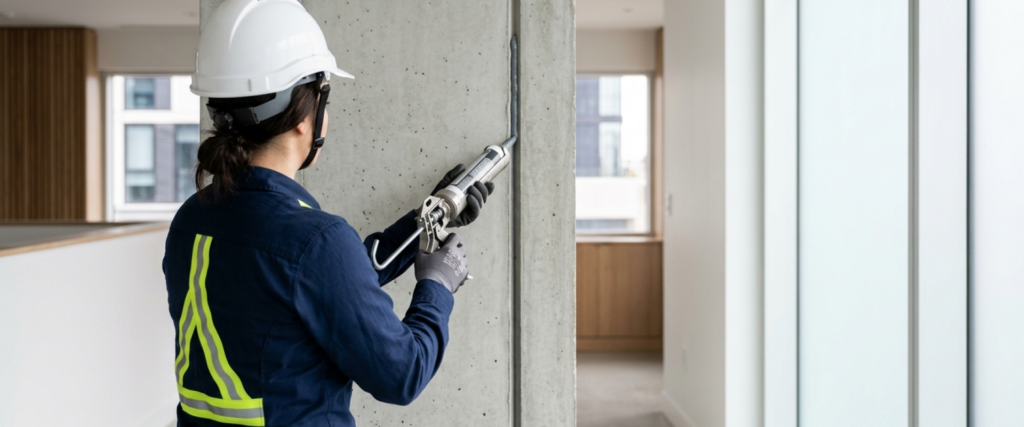
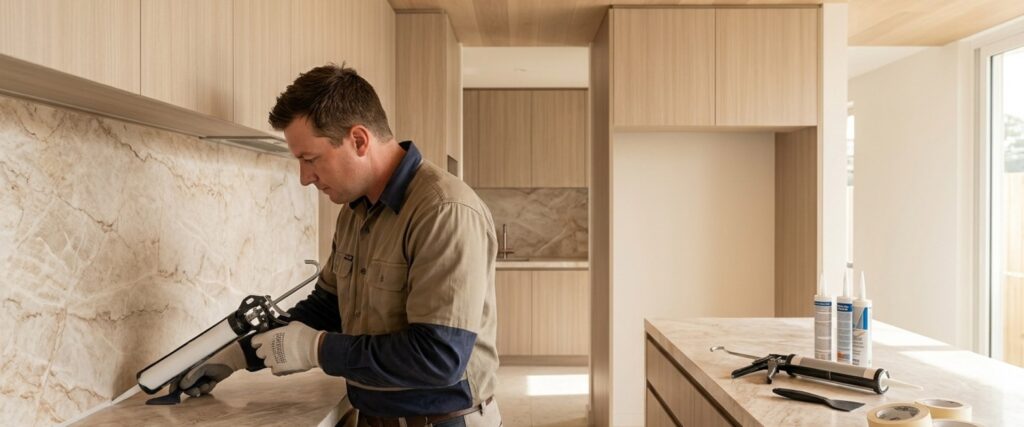
- Apply and tool the sealant. The sealant is gunned in a continuous pass so it fills the joint fully, then tooled to press it into the faces and give a clean profile. Masking keeps the frame and adjoining finishes clean.
- Remove masking and inspect. The bead is checked for voids, ridges and lifting before the area is signed off.
Application conditions matter too. Surfaces that are damp, very hot or contaminated will compromise adhesion, so on exposed facades we plan around the weather and the time of day. The same caulking & sealing methodology applies whether we are sealing a single ground-floor shopfront or working across many levels.
Sequencing sealing with other trades
Perimeter sealing depends on what happens before and after it. Frames need to be fixed and aligned so the joint dimensions are settled. Sealing that happens too early risks being cut, smeared or damaged by later trades. Sealing that happens too late can be blocked by scaffold, hoardings or completed finishes.
Cure time has to be built into the programme. Sealants skin and cure at different rates depending on the product, the joint size and the temperature and humidity on the day. Painters, cleaners and follow-on trades should not disturb a fresh bead. Our guide to caulking curing times and scheduling trades around sealing covers how to plan this without holding up the programme.
Who does the work matters as well. On facades, a specialist sealing contractor and a general trade can produce quite different outcomes on the same detail, and we have written about the differences between caulking specialists and general trades for Sydney facades. For head contractors, the practical point is to define responsibility for each junction in the scope, so that nothing is left between the glazier, the facade contractor and the sealant applicator.
Fire and acoustic considerations at frames
Not every frame perimeter is a plain envelope joint. Where a window or door sits in a wall with a fire or acoustic requirement, the sealing detail may need to form part of that wall system. That is a different question from weather sealing, and it should not be assumed. A standard sealant is not a fire-rated sealant, and an installation does not carry a fire or acoustic classification unless the specific system has been verified for that application.
Where the design calls for fire-rated sealing, the specified system and its documentation govern the work. We offer fire-rated caulking capability aligned with NCC and BCA compliance requirements, and our article on fire-rated caulking and NCC/BCA compliance for Sydney builders explains how that fits into a project. For projects where the requirement is unclear, the certifier and the design team should confirm it before we price the sealing.
What affects the cost of commercial caulking and sealing?
A frequent search is for a commercial caulking cost per foot or per metre. We do not publish rates, because a single figure hides the variables that actually move the price. On frame perimeters, the main drivers are:
- the total length and number of joints;
- access, including height, scaffold, swing stage or elevated work platform requirements;
- whether the work is new build or remedial, since removing failed sealant adds preparation;
- the substrates and whether primers or adhesion testing are needed;
- joint size and condition, including any packing or reshaping;
- the sealant system specified and the programme constraints.
The reliable route is a quote based on your drawings or a site inspection. Our external caulking service page outlines how we approach exterior and facade work, and a quote request from you starts the scope conversation. As a fully insured contractor with more than ten years of experience, we are used to pricing to tender documents as well as to site conditions.
Frequently Asked Questions
What is the difference between new build and remedial frame sealing?
New build sealing goes into a fresh joint with clean substrates and a set programme. Remedial sealing means removing failed or aged sealant, preparing the faces again and resealing, often on an occupied building with access constraints.
Which sealant is best for commercial window and door frames?
There is no single best product. Silicone, polyurethane and MS polymer each suit different substrates, finishes and exposures. The right choice comes from the frame finish, the adjoining material, the expected movement and whether the joint will be painted.
Do you need backer rod in a frame perimeter joint?
In most cases, yes. Backer rod controls sealant depth and supports tooling. Where the joint is too shallow for rod, a bond-breaker is used so the sealant bonds to the two sides only.
How long before a sealed frame can be painted or cleaned?
It depends on the sealant, the joint size and the conditions on the day. Some products can be overcoated and some cannot. Follow the manufacturer’s guidance and allow for cure in your programme rather than assuming a fixed time.
Do you supply the sealant guns or materials for sale?
We are a contracting business, so we supply and apply the sealants for the work we carry out. We do not sell products or tools over the counter.
Securing the envelope at every frame perimeter
Frame perimeters reward attention to detail. A joint designed to move, formed with the right backing, prepared properly and filled with a compatible sealant will do its job for years. A joint that skips any of those steps rarely does.
For head contractors, the practical takeaways are to settle joint dimensions early, confirm substrate compatibility, define who owns each junction and programme in the cure time. Where fire or acoustic performance is involved, treat it as a separate requirement with its own verified system.
Our team provides caulking and sealing services across Sydney, from new commercial builds to remedial work on existing buildings, and we are happy to talk through a frame sealing scope before it reaches tender.